I started my way up North after spending three nights in Homestead on the outskirts of the Everglades. Making my way along the Tamiami Trail I stopped off about half way across the glades to have a look for Snail Kite. The area just opposite the Shark Valley entrance to the Everglades National Park is supposed to be a good stop for the species. After about three stops I managed to get very brief views of one in my bins but it had disappeared before I could get it in the scope. I had one bird earlier in the trip on Lake Jackson but it was at a range of about a kilometre. These were unfortunately my only Snail Kites of the trip.
I had planned to make a straight run for the Gulf Coast but decided to make a few quick stops along the way in Big Cypress National Preserve. The numbers of waterbirds seemed to be far better here than my past two previous days in the disappointing Everglades National Park. Had I the choice again I would have done the Lucky Hammock area but wouldn't have bothered at all with ENP and concentrated on Big Cypress. Belted Kingfishers were just about on every second telephone pole. A quick stop at the Oasis Visitor Centre got me surprisingly my only Great Crested Flycatcher of the trip. The visitor centre itself was closed for some reason. I was still hoping for a few more warbler species so on the off chance I chose a random small road off the Tamiami Trail which lead to Burns Lake. I walked a few hundred metres up along the road with not a whole lot showing. I began to pish on the way back as I could hear a few distant warblers "chipping" in flooded Bald Cypress woodland. Within minutes the place was absolutely hopping with an assortment of warblers and other smallbirds. The flock consisted of Black-and-white Warblers, Common Yellowthroat, Northern Parula, Palm, Pine, Yellow-rumped, Yellow-throated, Prairie and Black-throated Green Warblers, Ruby-crowned Kinglet, Downy, Pileated, Red-bellied Woodpecker, White-eyed and Blue-headed Vireo, Tufted Titmouse and Carolina Wren. The birds were on every side, at all levels of the trees making it impossible to know where to look. At times there were so many birds all I could do was point my bins in a random direction and see what turn up in my field of view. It was a real struggle to tear myself away from the place and I really felt I had wasted my time in the Everglades NP.
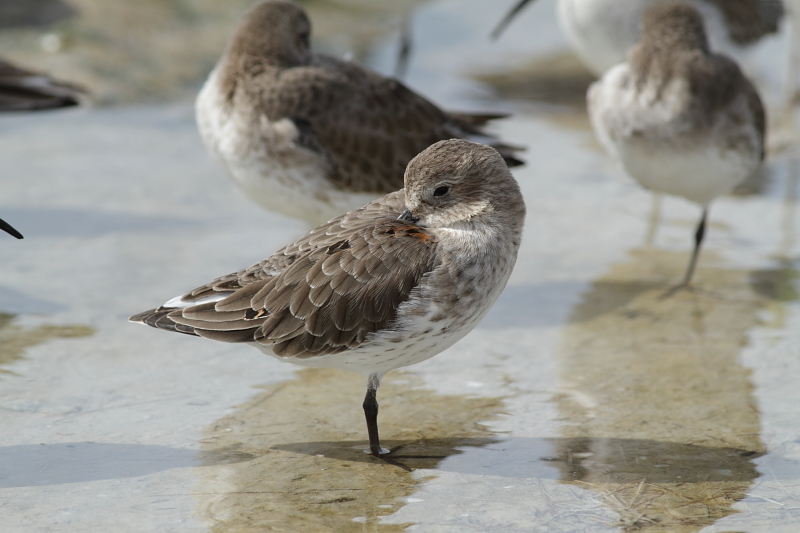
I made my way to the coast to Marco Island. My first spot here was Tigertail Beach, a good wader site. I had arrived at the wrong time for the tide as it was pretty much fully in. There was still thankfully a small selection of roosting waders present along with my first Wilson's Plovers. The birds were incredibly tame but looking straight into the sun hampered my attempts at photography. I also had four very distant but very distinctive Magnificent Frigatebirds off the beach. I decided try again later that evening when the tide would be lower.
I then had a look around the island for Burrowing Owls. Only two blocks back out the road from the beach I came across my first burrow. It like all the burrows were all fenced off with orange tape. It was on a busy crossroads in well developed suburban area and only four metres away from the "sidewalk". The birds was oblivious to power-walkers and myself. I've attached a Google Street image of the site itself. I came across at least three other burrows later. There seemed to be an incredible concentration of burrows on the island.
I tried Frank E. Mackle Jr. Community Park and an area around Frickney Road but these produced virtually nothing. Eagles Nest Community Park was much better with a good range of waterbirds and a bonus of Bronzed Cowbird in amongst large numbers of Common and Boat-tailed Grackles and European Starlings feeding on the floating vegetation on the ponds.
I finished up the day with a return to Tigertail Beach. The tide hadn't appeared to have changed a whole lot and I was quickly hounded out of the place by tiny but annoying Sand Flies. I headed on further North to the Fort Myers area for the next two nights.
 |
| Great Crested Flycatcher |
 |
| Great Crested Flycatcher |
 |
| White-eyed Vireo |
 |
| Blue-headed Vireo |
 |
| Black-and-white Warbler |
 |
| Black-and-white Warbler |
 |
| Pine Warbler |
 |
| Adult male Downy Woodpecker |
 |
| Bronzed Cowbird with Common Grackle |
 |
| Belted Kingfisher |
 |
| Wood Stork |
 |
| Adult female Anhinga |
 |
| Immature White Ibis |
 |
| Black-crowned Night Heron |
 |
| Blue-winged Teal |
 |
| American Black Vulture |
 |
| Turkey Vulture |
 |
| Second winter Blad Eagle |
 |
| Peregrine |
 |
| Burrowing Owl |
 |
| Burrowing Owls |
 |
| Google Street view of one of the Burrowing Owl burrows with the footpath running right beside it. |
 |
| Loggerhead Shrike |
 |
| Wilson's Plover |
 |
| Wilson's Plover |
 |
| Killdeer |
 |
| Killdeer |
 |
| Dunlin |
 |
| Curlew Sandpiper-like Dunlin, check out that honker! |
 |
| Dunlin |
 |
| Least Sandpiper |
 |
| Western Sandpipers |
 |
| Western Sandpiper |
 |
| Grey Plover |
 |
| Short-billed Dowitcher |
 |
| Short-billed Dowitcher |
 |
| Willet |
 |
| First-winter Forster's Tern |
 |
| First-winter Forster's Tern |
 |
| First-winter Forster's Tern |
 |
| Sandwich, Royal and Forster's Tern |
 |
| Royal Terns |
 |
| Adult Laughing Gull |
 |
| First-winter Laughing Gull |