Showing posts with label pink-footed goose. Show all posts

Friday, 14 October 2016

Mediterranean Gulls & Pink-footed Geese

A few shots from the last week or so. I came across a flock of six Mediterranean Gulls in Kilkieran Harbour feeding on the outflow from the seaweed processing factory on Thursday 6th October. One of the birds present was a green colour ringed first-winter from Zwillbrocker Venn in Germany which is right on the German/Netherlands border. It was ringed as a pullus on 18th June of this year and has moved approximately 1,100km to the west. This was the first re-sighting of it. 
I revisited the same spot again the following day and amazed to see that the flock had doubled in size to twelve - four first-winters and eight adults (there was a third-winter present on the 6th). The German bird was again present along with an Irish born and colour ringed bird 2X4N. This bird had been ringed by Tony Murray and co at Lady's Island Lake, Co. Wexford this summer.
ANNC German colour ringed first-winter Mediterranean Gull.
2X4N Irish colour ringed first-winter Mediterranean Gull.

Adult winter, third-winter & adult winter Mediterranean Gulls

Third-winter Mediterranean Gull.
Eight Mediterranean Gulls and one Black-headed Gull.

Ten Mediterranean Gulls
Seaweed Factory outflow.

While up on Achill Island last Sunday I had a nice flock of Pink-footed Geese fly in from the west. Pink-footed Geese are still fairly scarce along the west coast but have become more regular in recent years as the population is increasing. Female Garganey also on Sruhillbeg Lough.

Pink-footed Geese
Pink-footed Geese
Pink-footed Geese
Pink-footed Geese
Pink-footed Geese
Garganey


Wednesday, 27 November 2013

Pink-footed Goose Second Part

A few more of the Pink-footed Goose that's currently residing at Rusheenduff Lough.


Friday, 15 November 2013

Pink-footed Goose

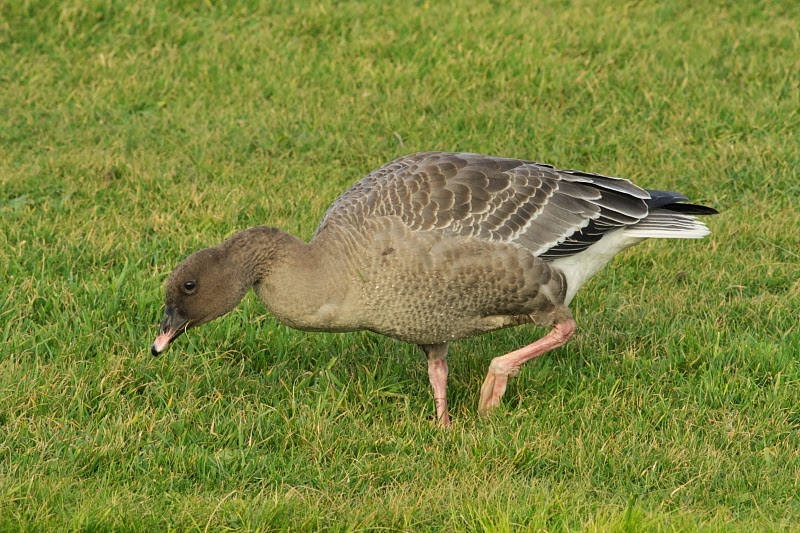
A few pictures of a very tame juvenile/first-winter Pink-footed Goose on Rusheenduff Lough beside Renvyle House Hotel on Wednesday. It had been associating with a few feral white farmyard geese for a week now and has been fed Oats by the staff of the hotel with the other geese each morning. I 'd believe it could well be a wild bird but may have got separated from its family group and/or may be injured. It's not at all unusual for the odd wild goose to tag up with captive/feral geese. Nice to see it at such close quarters.


Tuesday, 23 October 2012

Non Inishmore shots


A selection of non Inishmore pics from the last fortnight or so.

Pink-footed Goose, Omey Island, 19th October.

Common Gulls, Omey Island, 19th October.

Golden Plover, Truska, 13th October.

Golden Plover, Truska, 13th October.

Greenshank. Lough Rusheen, 14th October.

Record shot of the female type Blue-winged Teal, Rahasane Turlough, 14th October.

1st cal Peregrine, Crompaun Bay, Ballyconneely, 16th October.

1st cal Peregrine, Crompaun Bay, Ballyconneely, 16th October.

Female Kestrel, Ballyconneely, 16th October.


German ringed Meditterranean Gull, Mannin Bay, 22nd October.

German ringed Meditterranean Gull, Mannin Bay, 22nd October.

Friday, 12 October 2012

Inishshark Geese & Grey Seals

Some photos from last Friday taken on Inishshark just before things went completely mental here in Galway. I joined a few others from NPWS to help count Grey Seal pups on Inishshark who seem to be doing well. Four Pink-footed Geese were seen flying over the island even before we landed. These are presumably the same flock Anthony McGeehan had about two weeks ago on Inishbofin. Also eleven Barnacle Geese which I reckon were probably just arriving in. 470 were counted here on the last aerial survey in 2008. They are impossible to survey other that by the air due to being extremely flighty. They often fly off and move to other adjacent islands even before you can land on the island. Secondly more often than not it's usually not possible to land a boat on the island during the winter months due to heavy swells and poor/no harbour facilities.
This is one of the main reasons why Inishshark was abandoned by the very last of its 24 inhabitants in October 1960. Islanders were often stranded on the island for weeks at a time without any communication to the outside world or access to shops, a doctor and importantly at the time a priest. I'd really recommend watching "Inis Airc; BĆ”s OileĆ”in" (Inishshark; Death of an island) done by TG4 about island life and the evacuation. It's divided into five parts on Youtube, first one is here. Nothing left on the island now apart from the geese and seal. Very sad going through some of the old houses out there and just imagining what life would have been back in the day.
http://www.youtube.com/watch?feature=endscreen&v=VmXb2sIFJuY&NR=1

Pink-footed Geese

Barnacle Geese


This could actually be a Harbour Seal, doesn't seem to have the typical Roman-nosed appearance of a Grey.


This "looker" unlike all other female seals stands her ground every year we do the count. Not a lady you'd want to tango with!


Day old Grey Seal pup, whence the blood probably from the afterbirth.

Another very young pup having a little stretch, note the fresh umbrilical cord.

An older pup, note the old white furry coat being moulted.