Showing posts with label curlew. Show all posts

Monday, 15 February 2016

Colour ringed Curlew, ducks & divers

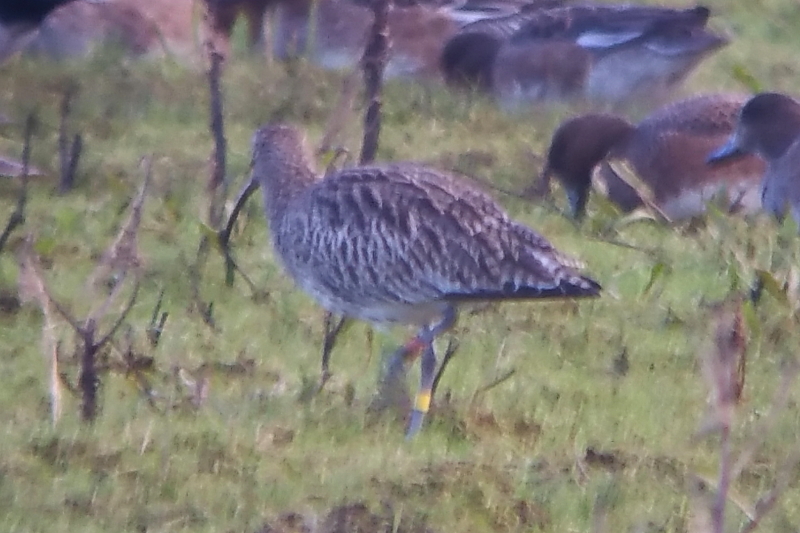
I a colour-ringed Curlew at Rostaff Turlough near Headford yesterday just across the county border on the Mayo side. I got word very promptly back from Alan Leitch, David Douglas and Jenny Weston all of the RSPB this morning.
It was ringed as a chick near Corgarff within the Cairngorms National Park, Scotland in 2014. Amazingly it was part of a clutch of six chicks. As most of you will know, waders as a general rule nearly always lay four eggs so six is most unusual. Jenny believes the extra two chicks may actually be from another clutch entirely and were adopted as it were by another pair. You learn something new everyday! Thanks to Jenny Weston for the use of the photo.
This is the second Irish resighting from the Scottish scheme with a bird also ringed in the same area and year being seen in Dublin last March. http://grampianringing.blogspot.co.uk/2015/03/a-curlew-sighting-at-last.html

Add caption


I also had a decent flock of 28 Greenland White-fronted Geese at Rostaff. A few noteworthy birds at nearby Belclare Turlough back across on the Galway side of the border as well. There was a very good sized flock of around 54 Greenland White-fronts feeding in adjacent feeds. Great to see a few family parties in amongst the flock. On the turlough itself I had a female Ring-necked Duck mostly asleep with Pochard on the Belclare village side of the lough. This is probably the first female I've seen in Galway in a few years now. In my experience female Ring-necked Ducks seem to have a greater tendency for associating with Pochard flocks over Tufted Duck. I suppose female Ring-necks do have a closer resemblance to female Pochard over female Tufted Duck. There seemed to more than the usual number of Pochard present (50 birds) so in my continuing search for a Redhead and/or Canvasback I came across a new hybrid combo for myself in the form of a male Red-crested Pochard by Common Pochard. It immediately drew attention in having much cleaner white flanks contrasting with a (darker) browner upperparts including brown primaries, a hint of the puffy head shape of RC Pochard with orange on the forehead, less black on the bill with a pink subterminal band and generally being a slightly bigger bird compared to Common Pochard. It's a very close match to the second hybrid depicted in the link below.
https://www.flickr.com/groups/444365@N25/discuss/72157604053970163/

Male Red-crested Pochard x Common Pochard

Male Red-crested Pochard x Common Pochard

Male Red-crested Pochard x Common Pochard

Male Red-crested Pochard x Common Pochard

Male Red-crested Pochard x Common Pochard

Female Ring-necked Duck

Female Ring-necked Duck

To finish up the day I headed out to Tawin Island to look for the Pacific Diver that was discovered here nearly over month ago now. Between one thing and another, mainly extremely rough weather, I hadn't had a chance to look for this bird since being refound by Paul Troake this year. This is most likely to be the same bird initially found here in 2009. It's been seen very sporadically here and at Rinville Point and at Finvarra Point which is just across the border in county Clare. Paul almost certainly had this bird last winter but the views were just too distant to confirm it. HIgh tide may be best for bringing the bird in closer to shore. I spent a good three hours trying to see the bird yesterday. It has been seen mostly along the northern side of the headland but I saw it directly west off the headland and unfortunately was rather distant. If it was tick for me I mightn't have been able to tick due to the poor views however as I saw plenty in California this time last year I was happy enough to add it finally to my county list. There less than twenty Great northern and around five Red-throated Divers present. The sea was reasonably settled but a biting northerly wind made conditions on the side of the headland a bit nippy! Most of the divers were distant as it was at low tide at the time. It's amazing how quickly you can call Great northern Divers at huge distance. It's hard to put into words but its just down to the jizz I suppose. This bird clearly wasn't a GND nor a RTD for that matter. The only other possibility was Black-throated Diver but this bird at no time display the characteristic white thigh patch of that species. The cheek/face area seemed darker compared to BTD. One feature which I found also rather useful was the sublime and very distinctive gentle curvature of  the head and neck. The nape area seemed much fuller but I didn't get the pale grey colour that's often seen in Pacific but again may have been due to the distant and light. It was also preening at one stage and was rolling onto it's side. Had it been closer in one would imagine that the vent strap would have been seen but alas no.

Tuesday, 25 November 2014

Albino Curlew

A few bits and bobs from the last week or so. I did the Galway Bay Count on Sunday along with Cathal Forkan. Weather wasn't too bad at all with reasonably calm seas. Nothing too strange on the count, the best bird was a fully albino Curlew at Bishops Quarter. Tom Murtagh found it on 16th September 2014 https://twitter.com/tgmurta/status/511994961365975040
It really is a stunning bird in real life and these heavily cropped shots don't do it any justice. This must one of the few genuine albino birds I've ever seen. I've seen multiple individuals of several species but they all invariably have some traces of normal pigmentation somewhere in their plumage or have a "ghost" pattern of their normal plumage. I had a leucistic Curlew two winters ago also in county Clare, pics below - must be something in the Clare water!
Having processing the few other pictures in this post I'm not long in remembering how bad the light gets here during the winter months. Its very difficult to get decent shots in Ireland during the winter even when the target is at close quarters.

Albino Curlew, Bishops Quarter, Co. Clare, 23rd November 2014.

Albino Curlew, Bishops Quarter, Co. Clare, 23rd November 2014.

Leucistic Curlew, Pouleenacoona Turlough, 9th February 2013.

Leucistic Curlew, Pouleenacoona Turlough, 9th February 2013.

Whimbrel, Roundstone, 13th November 2014.

Rock Doves, Murlach, 24th November 2014.

Rock Doves, Murlach, 24th November 2014.

Rock Doves, Murlach, 24th November 2014.
 
Blackbird

Song Thrush


Song Thrush
 

Tuesday, 23 September 2014

Inishmore Waders

A selection of shots of some of the waders from out on Inishmore over the (long) weekend.

Juvenile Curlew Sandpiper

Juvenile Curlew Sandpiper

Juvenile Curlew Sandpiper

Juvenile Curlew Sandpiper with Sanderling.

Juvenile Sanderling

Adult winter Sanderling

Adult winter Sanderling

Adult winter Sanderling

Adult winter Sanderling

Juvenile Sanderling

Curlew

Lapwing


Monday, 11 February 2013

9th/10th February 2013

Started off the day on Saturday at Rossaveel where there were 200 - 300 large gulls around the harbour. However there wasn't a single gull of note present. 100 more large gull on the beach at Spiddal but same story.
Rusheen Bay and Nimmo's Pier also deadly quiet.
Paul Troake had the Black Brant again on Friday near Newquay, Co. Clare so I headed down that way. A quick look in the usual fields failed to produce any geese so I went out as far as Lough Muree to check if they were out there. On arrival I noticed the male scaup-type duck on the lough along with a Greater Scaup, three Pochard and a female Tufted Duck. At a distance the head shape looked spot on for a Lesser Scaup. I began to wonder if the Lough Gash bird was on the move as this was also a first-winter bird. I bumped into Jeff Copner just after this and we both tried to get closer looks at the bird. We managed good views in behind the NUIG building. It looked smaller than the male Greater Scaup, closer in size to a female Tufted Duck that was present. Again the head shape had a definite peak to the rear of the crown with a tiny spike at the very rear of the crown which alot of male Lesser Scaup can show. There was a greenish sheen to the head. The upperparts were a noticeable shade darker than the Greater and unlike most hybrids I've seen previously the upperparts weren't as solid dark grey but with what looked like proper vermiculations. Unfortunately the closer views also showed that it had way too much black on the tip of the bill closely matching Tufted Duck. It also flew at one stage which revealed that 2/3's of the primaries were clearly white. It's most likely a Pochard x Tufted Duck hybrid. A nice reminder to check the wingbar on any possible Lesser Scaups in future. Were this bird seen at a distance where it mightn't be possible to check the bill it could easily be flagged as a male Lesser Scaup.

First-winter male hybrid duck.

First-winter male hybrid duck.

First-winter male hybrid duck, particularly Lesser Scaup-like here.

First-winter male hybrid duck.

First-winter male hybrid duck.

Sleeping first-winter male Greater Scaup on left with the hybrid duck and Pochards.
After Lough Muree I checked a few more fields near Newquay and managed to pin down the Black Brant in amongst a flock of Pale-bellied Brent Geese. The views were distant so I couldn't get any shots on this occassion. I've attached a shot of what must be the bird that I had near Traught in Galway on 4th November.


Adult Black Brant, near Traught, Co. Galway, 4th November 2013.
I headed further South from here to check on the male Ring-necked Duck that has been on Lough Roo, no joy here as it was getting dark and I just didn't have the time to check the hidden corners. I did have this leucistic Curlew nearly though, shots crap as it was near dark at the time.

Leucistic Curlew, Pouleenacoona Turlough.

Leucistic Curlew, Pouleenacoona Turlough.
I headed up to Achill island on Sunday to check to see if the Black Duck was still up there and sure enough it was. I'm surprised that anyone has managed to get any decent shots of this bird as the whole duck flock are particularly flighty on this very open lake. I really had to struggle to even get these record shots. It was accompanied by three female hybrids which showed limited white borders to the speculum and pale tails.
I also had a male Ring-necked Duck on Keel Lough with a flock of Tufted Ducks with a first-winter Iceland Gull drifting over also. This was only the second Ring-necked Duck I've seen this winter. The bays and coves around Doogort, Dooagh and Keem were all extremely quiet with virtually nothing in them.

Male American Black Duck, Sruhill Lough, Co. Mayo.

Male American Black Duck, Sruhill Lough, Co. Mayo.

Tuesday, 21 February 2012

21st February 2012

Headed out to Rahasnae Turlough to have a nosey about for the American Wigeon. I don't think it's been really looked for since I last had it a fortnight back apart from Rich Bonser. The place was packed with duck and I spent the next two and half hours going through the throngs of birds. Best I could manage was an apparent male American x Eurasian Wigeon, a pair of Shelduck (site tick for me), a tight pack of 33 Little Egrets and a "unkindness" of five Ravens.

 Male American x Eurasian Wigeon, Rahasane Turlough.

  Male American x Eurasian Wigeon, Rahasane Turlough.

 A small part of the horde at Rahasane.

33 Little Egrets by my count.

Must have been a deep animal in the immediate vicintiy, note the full crop.

Had a look around Ahapouleen Turlough,Tawin Island, Kilcaimin and Ardfry. High tide was in so the numbers of birds were low enough.