Showing posts with label cattle egret. Show all posts

Thursday, 28 February 2019

Murlach Cattle Egret

A few more random shots from the past Autumn including Galways only second record of Cattle Egret. The bird was picked up by David Rees on 30th September down by Murlach. It hung around for at least two weeks.
A few shots of some of the returning Icelandic colour ringed Oystercatchers which will very shortly be heading back North. Also a young Peregrine which was unsusually perched on telephone wires.

Cattle Egret, Murlach, 30th September 2018.

Cattle Egret, Murlach, 30th September 2018.

Juvenile Peregrine, Murlach, 13th October 2018.

OO-W(PA) colour ringed Oystercatcher, Bunlough Strand, Co. Mayo, 14th September 2018.

OO-W(PA) colour ringed Oystercatcher, Bunlough Strand, Co. Mayo, 14th September 2018. Ring already damaged on one side, only ringed in May 2017.

RL-W(AA) colour ringed Oystercatcher, Inner Mannin Bay, 10th August 2018.

Saturday, 3 February 2018

The Netherlands December 2017

A belated post on a short trip over the Netherlands I did back in December. I flew into Schiphol Airport in Amsterdam on the morning of the 12th and left again on the afternoon of the 14th. The primary goal of the trip was to try and catch up with Lesser White-fronted Goose and Red-breasted Goose. I succeeded in accomplishing the latter target but was rather unlucky in the former. There had been several reports of different Red-breasted Geese on and off during the previous month at a few spots across the country. The nearest report was only a few kilometres north-west of Rotterdam from where I based myself for the next two nights. My trip coincided with decent amounts of snow which had been on the ground for a few days. Every road was perfect but it did have an effect on the birds especially the geese. After going through several hundred geese (the majority being Russian White-fronted and Greylag with smaller numbers of Barnacle, feral Canada and Egyptian Geese) I eventually picked up a pair of Red-breasted Geese which had been previously reported in the general area of Noord-Kethel. They were in a relatively small flock of geese but were about 800 metres away. Even at that long distance they were obvious enough especially for a goose! It would have been nice to have decent look at what was a lifer for me but I should glad I managed to see them at all. With the poor light already decreasing I made a bee-line for the Lesser White-fronted Goose location - Oudeland van Strijen. This is one of the main wintering grounds for the small Swedish breeding population. I ran into a helpful Dutch birder who pointed me in the right direction. I also had good information on the location thanks to the very useful Waarneming.nl website. The Dutch birder also mentioned that the snow could have pushed off the geese to another snow-free site. I searched the spot until dark but didn't get a sniff of any LWFG.

I started my second day at this same spot first thing in the morning after eventually managing to escape the Rotterdam traffic. I could see that the snow was slowly starting to disappear but there were still significant snow coverage. While scanning from the car I managed to drain the car battery of the rental car. The automatic headlights remain on if the keys are left in the ignition. Lucky I managed to convince a passing local to give me a hand to jump-start the bloody thing, lesson learned! After a few hours without any success I decided to head out to the coast and birded the area near Stellendam. This consisted of more polderland, sand dune systems, saltmarsh and mudflat. A few nice species here included Spoonbill, Cetti's Warbler, Firecrest, Snow Bunting, Brambling and Twite.

I only had a few hours to spare on the third day before flying home. Most of the snow had now melted. I was back again at the polderland near Strijen to look for LWFG. There was huge increase in the numbers of geese in the area particularly Barnacle Geese which had been largely absent the two previous days. There must have been several thousand geese in the whole area. I again searched the usual LWFG spot from all angles but had no joy. With an increasing mind-numbling migraine pounding in my head I called it a day and made my way back to the airport. I checked a large park within Rotterdam hoping for a few woodland species but saw little of note to be honest. I'm not sure if the Netherlands has a national bird but if not then it should probably be Eurasian Coot with the huge amount of water in the country, they seemed to be everywhere. It was interesting to see so many Great White Egrets throughout the country. I even managed to "twitch"three Cattle Egret at the LWFG site, they are still considered a rarity in the country. I didn't see a single Little Egret though?
I took virtually no shots during the three days. Shortly after arriving back in Dublin I checked the Waarneming site to see if there had been any news reported from my last day. It was a little soul destroying to see a report of 23 Lesser White-fronted Geese and a single Red-breasted Goose from Oudeland van Strijen after I had left!

Cattle Egret, Oude van Strijen, Netherlands, 14th December 2017.

Cattle Egret, Oude van Strijen, Netherlands, 14th December 2017.

Common Buzzard, Oude van Strijen, Netherlands, 14th December 2017.

Common Buzzard, Oude van Strijen, Netherlands, 14th December 2017.

Red-breasted Goose, Noord-Kethel, Netherlands, 12th December 2017.

Noord-Kethel, Netherlands, 12th December 2017.

Noord-Kethel, Netherlands, 12th December 2017.

Tuesday, 3 March 2015

California 5th February 2015

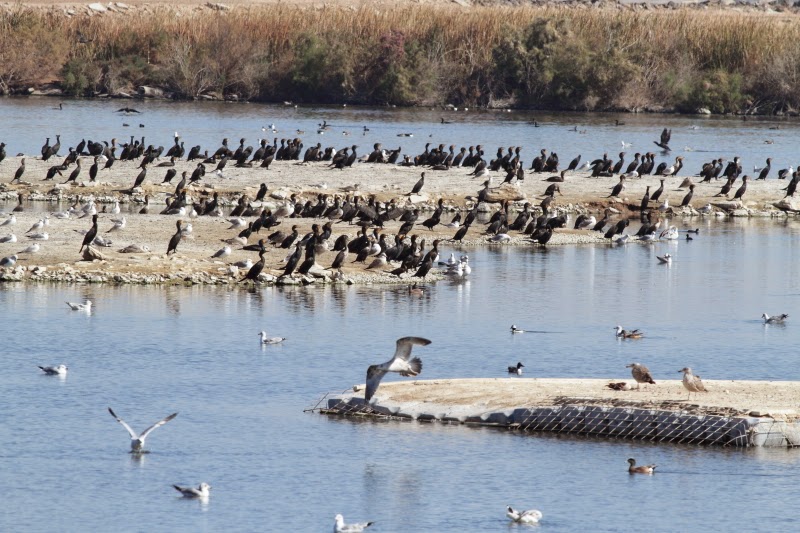
So we spent the whole day around the Salton Sea area today. Some fantastic wetland birding again with colossal numbers of ducks, waders and gulls which are probably my favourite groups of birds. Salton Sea is well known for being the only regular spot in the whole US for Yellow-footed Gull. The best numbers are found during the summer months and I assumed that we would be extremely luck to even come across a single bird at this time of year. By midday we had managed to find a first-winter, a second-winter and up to four adult-types! Most of these were found on the saline pond at the Sonny Bono Salton Sea National Wildlife Refuge or nearby on the lakeshore.
We also had nice views of Ross's Geese in amongst the Snow Geese but there didn't seem to be any young Ross's present. We also had a single White-fronted Goose here which may have been Pacific White-front Anser albifrons sponsa which seems to be the best fit. It was the only one that we saw at Salton Sea. At the Sonny Bono visitor centre we had some close views of Gambel's Quail which seemed to be feeding on grain laid out especially for them.

Afterwards we had a walk around some of the fodder fields for Sprague's Pipit. As we zig-zagged our way through the fields we gradually got closer and closer to large complex of buildings. As we eventually ended up right beside the border fence to this complex it became obvious that it was Brawley State Penitentiary! Right on cue a 4x4 came out to investigate us from inside the complex. At this point one of group members decided to take some shots of a Savannah Sparrow sitting up on the perimeter fence. Not exactly the wisest thing to do. Myself and others "gently encouraged" him to desist in his actions. I was fully expecting law enforcement to waiting for us on our arrival back to the minivans but thankfully they must be used to moronic birders like us at this stage. After all that effort and hassle we failed to connect with the pipit but there was always tomorrow...

To finish up the day we headed to Unit 1 of the Salto Sea NWR. We had more Ross's and Snow Geese along with Sandhill Cranes in the adjacent fields. The marsh beside the lake was full of duck, Pintail in particular but we also saw good numbers of Black-crowned Night Herons, a single American Bittern in the near darkness and heard more Ridgway's Rails.

American Bittern, last bird of the day.

Juvenile Black-crowned Night Heron
Mostly Double-crested Cormorants

Brown Pelicans

Cattle Egret


Sandhill Cranes

Greater Sandhill Cranes with a single Lesser Sandhill Crane?


Sandhill Crane

Sandhill Crane
Mostly Pintails

Mostly Pintails

Ross's Goose

Ross's Geese with a juvenile Sow Goose on the left in the background.

Ross's Geese with a juvenile Snow Goose on the right.


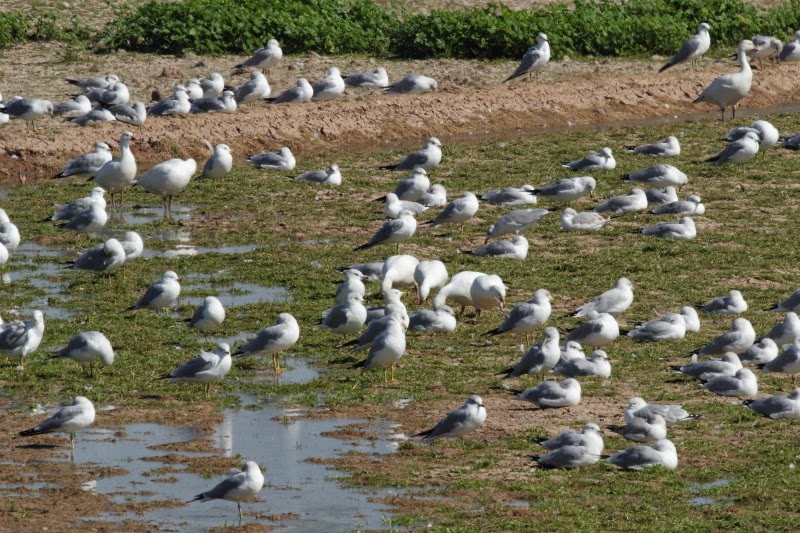
Ross's Geese in amongst Ring-billed Gulls, not a huge size difference! Single Snow Goose in the top right corner.

Mostly Snow Geese with a dark morph bird in the centre. Nearly all the Snow Geese seen were white morphs.

Mostly Snow Geese.

Mostly Snow Geese.

Mostly Snow Geese.

White-fronted Goose with juvenile Snow Goose.
 
Female Shovelers
Female Northern Harrier

Male Northern Harrier

American Avocets and Black-necked Stilts

Greater Yellowlegs

Greater Yellowlegs

Greater Yellowlegs

Greater and Lesser Yellowlegs
 

Lesser Yellowlegs
 
Long-billed Curlew
First-winter Yellow-footed Gull, the white underparts really made it stand out from the other young large Nearctic gulls.

Adult Yellow-footed Gull

Adult Yellow-footed Gull on the left with a first-winter Thayer's Gull on the right.

Yellow-footed Gull on the right with a California Gull on the left to compare upperpart tones.

Phone-scoped pic of a different Yellow-footed Gull.
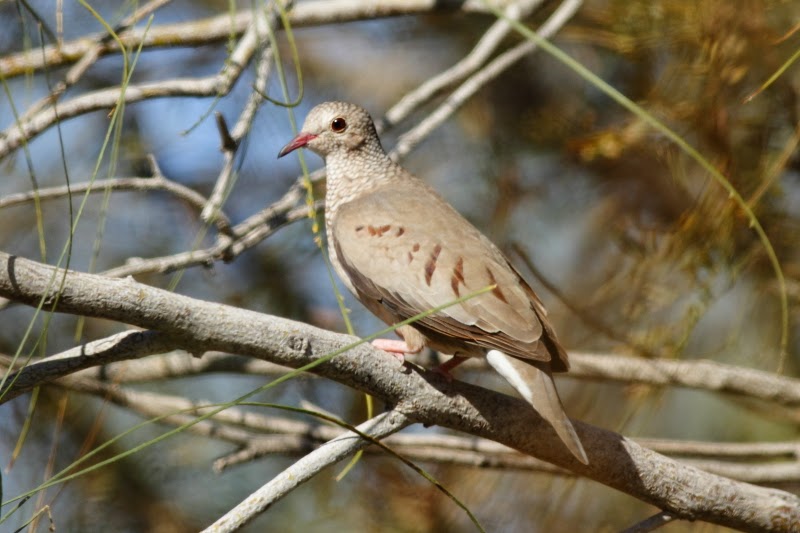
Common Ground Dove


Male Gambel's Quail

Male Gambel's Quail

Male Gambel's Quail


Male Gambel's Quail
Female Gambel's Quail