Showing posts with label murlach. Show all posts

Sunday, 7 September 2014

Murlach Ortolan Bunting

I got a text from Richard Bonser to say that his Swiss birding friend Julien Mazenauer had found an Ortolan Bunting down by Murlach at Ballyconneely (thanks Rich). I was at a meeting in Offaly for most of the day and it was 1900hrs by the time I got back to have a look. The light was going and it wasn't too approachable but I managed to get a few record shots which are below. This is the second county record of this species after the first one turned up on Inishbofin from 10th to 12th September 2012 which was found by Craig Nash, see here
http://dermotbreen.blogspot.ie/2012/09/ortolan-bunting.html.
Ortolan Bunting is the only rare bunting on the Galway list. Clare for example has had one Black-headed, one Rustic, several Little and also several Ortolans at this stage. The bird in question here favoured a field just past Murlach and also feed along the laneway itself. It was quite vocal in flight.
I've uploaded a video of the bird on Vimeo taken on the phone which was shot through Michael Davis's amazing 95mm Swarovski scope.
https://vimeo.com/105493613


Saturday, 9 November 2013

Lesser Scaup, Murlach

Murlach strikes again. In the last year now it's had American Coot, Green-winged Teal and Lesser Yellowlegs, amazing we you think it's had nothing in five years of coverage up until this time last year. I was doing the I-WeBS with the bossman Ger O'Donnell yesterday down at Ballyconneely. I picked up the American Coot while doing the same count here. While counting Murlach I had a female Tufted-type Duck out on the lake. I didn't have much time to eyeball it as we had places to go and birds to count but it did look interesting. I came back after finishing the counts but the light was nearly gone at this stage. After a lot humming and hawing I knew I would have to come back in the morning as I just couldn't make out the exact bill and on the two occasions it flapped it's wings I was at the wrong angle to properly make out the wing pattern. It spent most of its time diving so the head shape was very noticeable as it had crown feathers depressed in between dives for most of the time.
I spent two hours with the bird this morning. Again it spent most of its time diving in amongst the 27 Mute Swans present. There were times where I almost had myself convinced it was a Tufted Duck as the head shape again wasn't as eye catching while feeding. However the head shape was far more noticeable when the bird was relaxed or alert.
It approached to within 100 metres this morning. Even at that range it was still hard to make out the bill pattern in the dull overcast conditions. The whole bill was fairly dark grey which made examining the bill tip again tricky. It had a small black nail with some limited darkness bleeding either side of the nail but this doesn't seem too unusual for Lesser Scaups of this age and sex (see below). As it was the only diving duck present it was impossible to judge it's overall size. I don't recall ever seeing any diving duck from this site at all actually. It could be aged by the very dull eye and is most likely a female as a young male should show some signs of the sex at this stage such as new grey feathers to the upperparts or new black feathers on the head, neck or breast. Thankfully the bird eventually flapped after a spot of preening and revealed the classic Lesser Scaup wing bar consisting of clean white secondaries sharply contrasting with grey primaries. I had a Lesser Scaup-like drake Aythya hybrid in Clare last winter which had white on the secondaries and this continued onto the inner primaries while the outer primaries were grey.
http://dermotbreen.blogspot.ie/2013/02/9th10th-february-2013.html
The shots of the Murlach bird are only record shots taken at long range in poor light and are fully cropped but they at least give you an impression of the bird. Were this bird at longer range in with large numbers of duck for example at Lough Corrib it's entirely possible it mightn't have been picked out or clinched.

Head shape not very striking between dives.

More typical Lesser Scaup head shape.


Showing the high crown with the peak behind the eye.

This and the pic below show the distinctive wing pattern and even the head shape.


All shots below are from Florida taken in slightly better light and closer range from last winter.

Add caption

Young females in front on extreme left and the right. Adult female fifth from the left with brighter eye colour and darker head and neck contrasting with paler greyer body.

From left to right, adult female, first-winter male and first-winter female. Note the difference in the head shape of the 1st winter female compared to the adult female. Head shape can be radically altered by the mood of the bird.


First-winter female with a "messy" bill tip with dark subterminal areas adjacent to the nail.

Murlach between Ballyconneely and the strand to the south.

Tuesday, 24 September 2013

Murlach Lesser Yellowlegs Part Deux

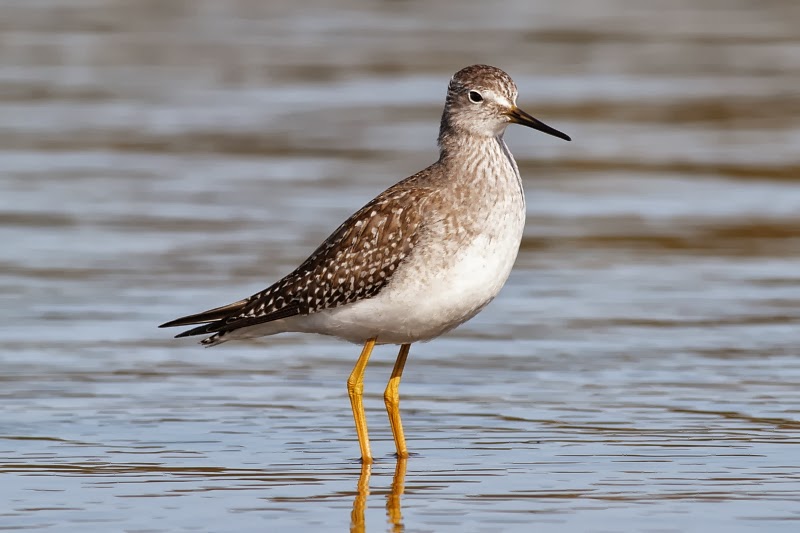
Some more shots of the juvenile Lesser Yellowlegs taken yesterday. Showing rather well, helps if you don't have any pesky Redshanks in the area shouting their heads off.

Also juvenile Curlew Sandpiper at Rossadillask, Cleggan yesterday while doing more I-Webs counts, the first I've seen this year in Connemara. While the species is fairly scarce they aren't as bad as Little Stint of which I've seen a grand total of one in the last six Autumns out here!


With a shield bug of some sorts.


Juv Curlew Sandpiper, Rossadillask.

Friday, 20 September 2013

Lesser Yellowlegs at Murlach

I got a call from Miryam Harris just as I was arriving into Ballyconneely late this afternoon. Mike and herself had just found a Lesser Yellowlegs down by Murlach. I had planned on checking the machair at Aillebrack and Truska for American Golden Plover as Aonghus O'Donaill had found a juvenile at Rahasane turlough earlier today. I obviously never made it down to either to Aillebrack or Truska for that matter.
I had last checked Murlach while doing an I-WeBs count here on Wednesday so it was obviously fresh in. The bird gave great views and was quite approachable.

Previous county records are as follows;
One, Rahasane Turlough, 20th January 1977.
One, Rahasane Turlough, 7th October to 9th November 2001.
One Glenamaddy Turlough, 9th to 12th October 2011.
There is also a record from Rahasane Turlough (yet again) from 26th September to 13th October 2003 which was never submitted but was photographed. We should be able to get it accepted thanks to the shot.


Murlach. It was feeding very close to the roadside along the fenceline here.

Wednesday, 28 November 2012

American Coot

I was finishing up some I-WeBS counts down around Ballyconneely at around 1030hrs this morning. The last time I attempted to undertake a count at this site I got nicely bitten on my left wrist by a sheepdog. The wrist is only now back to normal. Anyway the first site to cover was Murlach, a small brackish lough located between Ballyconneely village and bay. It a great looking spot and has a real rarity hotspot look about the place especially for waders but it's never produced anything really in the five years that I've been in the area, a single Ruff this Autumn was probably the best I've had in there to date. So while counting from a second viewpoint on the south side I had distant views of what I initially thought was the back end of a Moorhen. Thankfully it turned around and produced an all white bill. White undertail coverts on a Coot - couldn't be anything else but American Coot!
The bird moved happily around the lough. Some of the back pools and channels were frozen over. It feed easily by upending and occasionally diving.

There's no way of knowing how long the bird has been present here as the place hasn't been checked in around three weeks. However the UK only got its seventh record just two days previously up on South Uist on the Outer Hebrides so maybe this bird isn't too long.
I had seen an American Coot found by Dave Suddaby two years ago up on Termoncarragh Lough on the Mullet penninsula. This bird showed up on 15th November 2010 and stayed until 9th April 2011. This was only the second Irish record, the first was at Ballycotton, Co. Cork back in7th February to 4th April 1981. Will my bird hang around until next April? Time will tell.

I've never even seen Eurasian Coot in the Ballyconneely/Slyne Head area and have only seen them less than three times in Connemara before. The No.1 and 3 best Irish sites for Eurasian Coots both lie within county Galway. Lough Corrib is the most important site for the species in Ireland. A peak of 20,444 birds were counted during the 2003/2004 count season though numbers have decreased dramatically mirroring the huge declines here also of diving duck. The last count I have to hand is the 2008/2009 count when only 4,840 were counted. 1,500 to 2,000 Coots are found at the third best site - Loughrea. I've often looked through these vast flocks wondering what the chances of picking up an American were and as to how noticeable the white undertail coverts would be in comparsion to their Eurasian relations. I must say the undertail coverts were eyecatching at all times today on Murlach bird.


Proof that these shots ain't from Florida!


The Mayo bird, photographed 16th November 2010
American Coots, Orlando Wetlands Park, Florida, 7th November 2012.