Showing posts with label Siberian chiffchaff. Show all posts

Saturday, 12 November 2016

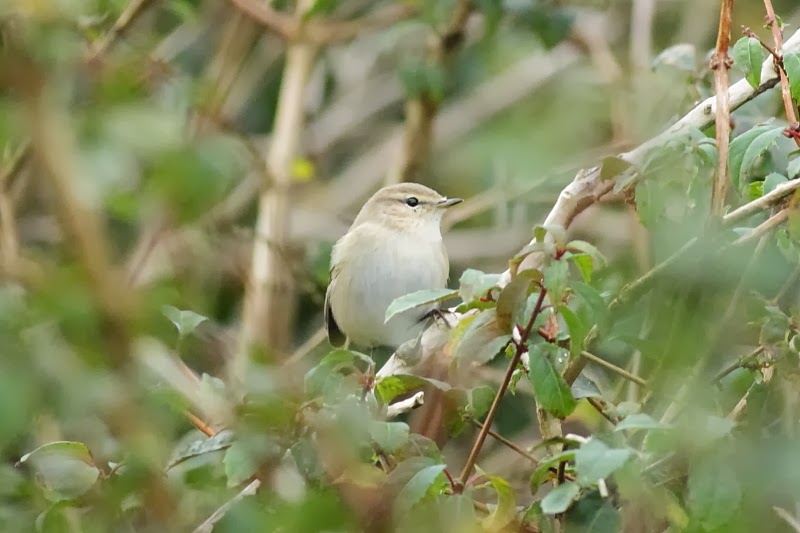
Siberian Chiffchaffs, Ballyconneely area, Nov 16.

A couple of shots of two different Siberian Chiffchaffs from the Slyne Head/Ballconneely area recently. Thankfully both birds were heard calling especially the bird near Ballyconneely village.
Both matched this bird recorded calling in Russia perfectly. http://www.xeno-canto.org/339799. Most of the previous birds out here seemed very reluctant to call confirming the identification. I have a recording of the village bird but couldn't upload it onto to Xeno Canto as it in WAV format.
The bird near the village on the 7th November was mainly in Willows that still largely have their foliage. It kept company with a typically calling Common Chiffchaff and also another Common Chiffchaff giving the "sweo" call http://www.xeno-canto.org/342033. I revisited the area again today and there were two Siberian Chiffchaffs with possibly four Common Chiffchaffs in the exact same spot, I wonder if they are going to overwinter. This is adjacent to Murlach and immediately East of Murlach Mooring holiday homes.
There were at least 32 Siberian Chiffchaffs recorded in Ireland during October. They were probably more numerous than scarce warblers such as Lesser Whitethroat, Garden Warbler, Wood Warbler, etc.
The Red-breasted Flycatcher was again present in the Trident Garden also.

Siberian Chiffchaff, Conneely's Garden, 1st November 2016. 
Siberian Chiffchaff, Conneely's Garden, 1st November 2016.


Siberian Chiffchaff, Conneely's Garden, 1st November 2016.

Siberian Chiffchaff, Conneely's Garden, 1st November 2016.

Siberian Chiffchaff, Conneely's Garden, 1st November 2016.
 

Siberian Chiffchaff, Conneely's Garden, 1st November 2016.

Siberian Chiffchaff, Ballyconneely village, 7th November 2016.

Siberian Chiffchaff, Ballyconneely village, 7th November 2016.

Siberian Chiffchaff, Ballyconneely village, 7th November 2016.

Siberian Chiffchaff, Ballyconneely village, 7th November 2016.

Siberian Chiffchaff, Ballyconneely village, 7th November 2016.

Siberian Chiffchaff, Ballyconneely village, 7th November 2016.

Siberian Chiffchaff, Ballyconneely village, 7th November 2016.

Wednesday, 30 October 2013

Slyne Head 29th October 2013

I had a quick look down around Slyne Head yesterday lunchtime in the hope that the recent storm may have dropped something nice in from across the pond. Most of the action was around the Trident garden with one tristis Chiffchaff, 1-2 Chiffchaffs, Spotted Flycatcher and a Pied Flycatcher (last two very late migrants) in the area.
The tristis kept company with a collybita calling Chiffchaff. Both looked extremely similar to each other (the Chiffchaff possibly had a yellower supercillium) and weren't readily easy to separate. Thankfully the Siberian Chiffchaff gave the characteristic call of that race. Another very Siberian-like Chiffchaff in a garden across the road was also heard to call like a typical collybita. The exposure of most of the Siberian shots wasn't quite right as it was very overcast at the time. They are heavily cropped which doesn't help the quality either.
There was a Long-eared Owl (possibly a resident bird as opposed to a migrant), Crossbill, 2 more Chiffchaffs and a Blackcap nearby also.
Nothing with the flock of 250 Golden Plovers at Truska. It's looking like 2013 may be the first time I haven't found at least a Pectoral Sandpiper or American Golden Plover in this area, the first time in the six Autumns I've been checking it.

Siberian Chiffchaff.

Siberian Chiffchaff, almost Booted Warbler like in colour tones.

Siberian Chiffchaff

Siberian Chiffchaff

Siberian Chiffchaff

Siberian Chiffhcaff

collybita Chiffchaff (on call).

collybita Chiffchaff (on call).

Pied Flycatcher

Spotted Flycatcher

Spotted Flycatcher

Spotted Flycatcher

Raven
 

Tuesday, 25 December 2012

Siberian Chiffchaff

 While out on Inishbofin last Thursday I came across what I was sure was a Siberian Chiffchaff. It was feeding with a Common Chiffchaff along a small drainage ditch next to Doonmore Hotel. The two birds were really chalk and cheese. It spend most of its time feeding in the drain but also spent time feeding with the Common Chiffchaff in an adjacent bed of rushes. I managed to download a recording of a calling Siberian Chiffchaff onto my phone and played it to the two birds to see what sort of reaction I'd get. The Siberian bird flew directly towards me and did an near 360 of me at close quarters. The Common Chiffchaff showed zero interest whatsoever. During this time the Siberian called a handful of times perfectly matching the recording with a monotone, mournful cheeep (or something like that, I'm useless at transposing calls onto paper).
The bird could transform in appearance depending on light conditions. In bright light the greenish fringes to the primaries and the tail feathers could be quite pronounced resembling a Bonelli's Warbler at times. In duller light this wasn't as pronounced. The axillaries and underwing coverts were bright lemon strongly contrasting with the rest of the plumage. The area from the back/mantle up to the head and down to the breast was a lovely khaki light buff colour. This was most intense on the ear coverts with some russet tones especially in stronger light. This was probably the most eye-catching part of the plumage for me. Stuck between the rusty ear coverts and a darker brown forehead and crown was a noticeable light buff supercillium. Only the lower half of the white eye ring was visible, the upper section melted away into the white buff supercillium.  The entire belly was cold grey with warm buff rear flanks and undertail coverts. The lower mandible was mostly pale which seems a little off for Siberian Chiffchaff? The legs were all black with yellow soles to the feet. It also exhibited some olive to the rump and the uppertail coverts which is ok for tristis apparently.
Unfortunately I hadn't brought my camera out with me so I had to go back out on Sunday to get some shots. There was no sign of the Common Chiffchaff which was a pity as it would have been nice to get some shots of it too just to show how different the two were.
I had an adult Glaucous Gull out there on Thursday and a first-winter Iceland Gull on the Sunday also.

Bright lemon axillaries and underwing covert sharply contrasting with the tan brown tones of the head.


At times the head pattern was almost reminiscent of Garden Warbler without the pure grey tones.


Some slight olive tones to the rump and uppertail coverts but apparently ok for tristis?

Yellow soles to the feet, rest of the legs black.


Bill not all black but again apparently still ok for tristis.

Iceland Gull