Showing posts with label redwing. Show all posts

Friday, 30 March 2018

March 2018

A few random shots from the last month or so. Some shots of various Redwings (including one possible Icelandic candidate) which turned up during the recent "Beast from East" cold weather incident which effectively closed down the entire country for four or five days. We had less than 24 hours of snow in Connemara so it really didn't hit us significantly.

Just back form a ten day trip to Taiwan so expect of plenty of shots from there over the next while.

Irish Hare
Irish Hare


Oystercatchers

Male Pied Wagtail

Male Pied Wagtail

Male Pied Wagtail

Meadow Pipit

Redwing

Redwing

Redwing

Redwing

Redwing

Redwing

Redwing (possible Icelandic bird).

Redwing

Redwing

Sunday, 8 November 2015

Inishark Grey Seals 4th Nov 15

We were out on Inishark and the surrounding islands again during the week to carry out another count of Grey Seal pups. They seem to be having a good year. There were a couple of casualties recently though with one adult female and ten dead pups encountered. Many of these were in dangerous coves. We had a very large swell last week which combined with high tides and bad weather meant that some were trapped in these coves with no where to escape from the battering waves. Some of the younger pups may have drowned or become hypothermic as they are unable to survive for long in the water when young. The adult female looked like she was absolutely pummelled as she may have been trying to protect here pup.

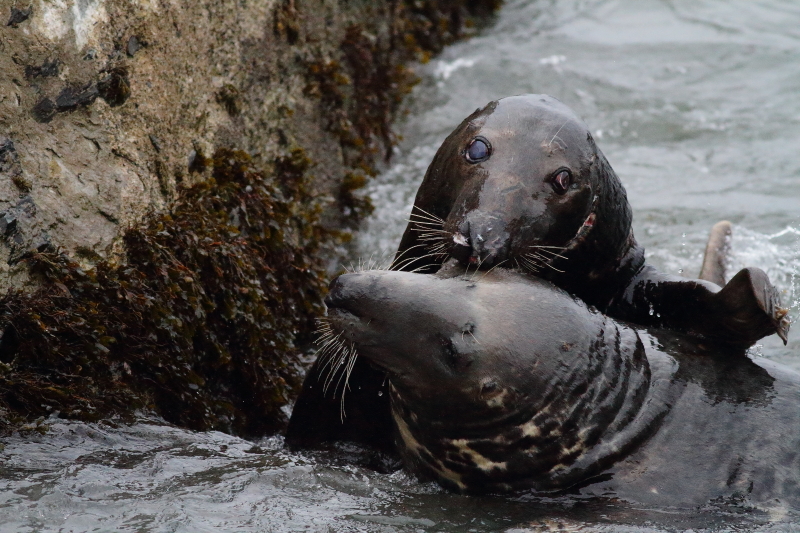
As we landed on Inishark we saw two bull Grey Seals doing battle right by the slipway. They can be fairly ferocious when they go at each other. If you're of a squeamish nature then the photos below may not be for you! Both had numerous fresh battle wounds and blood was literally flying. They were obviously fighting for the right to mate with the females in the area. One of the males seemed to have the upper hand for most of the time. It was only on editing the photos for this post that I realised that this dominant male had a cataract or was possibly even blind in the right eye. I remembered the male with a similar damaged eye which we saw in the exact same spot back in November 2013 which had the GPS Phone Tag attached to his head. It had been caught in Brittany, France twice and on both occasions has made it's way up to Inishark for the autumn.
http://dermotbreen.blogspot.ie/2013/12/inishshark-27th-november-2013.html
When I compared my photos from November 2015 and November 2013. I was able to find at least three unique marks on the head which confirmed that it was actually the same male! He has earned himself quite a few more battle scars during the last two seasons. The tag is glued onto fur but is shed when the male moults each year. It must surely have made the same journey many times now although he obviously hasn't been tagged this year.

While I mention seals there was an interesting piece in the news about a week back which was reporting on research addressing the theory that seals compete with Irish commercial fish stocks.
http://afloat.ie/item/30438-seals-not-competing-with-commercial-fishing-stocks-says-new-research
The study was carried out by the Queens University Belfast, University College Cork and Marine Institute. They found that "seals are not threatening commercial fishing stocks in Irish waters, with the possible exception of wild Atlantic salmon". While they can cause damage to static fishing gear they have no significant negative effects on commercially fished species along the south and west coast of Ireland. As mentioned by the study the huge majority of Salmon sold in Ireland is now farmed which if run properly should be immune from the attention of seals. When they do cause damage to fish in nets it's usually down to just a few individuals who have learned about an easy source of food. Seals along with Cormorants have long been demonised throughout the world by fisher folk and I'm sure this scientific study will do nothing to change many minds in the industry here. I was at a talk a few years ago given by a fisheries officer who was suggesting a Cormorant cull while using a picture of Shag as part of the presentation - need I say more. When had a locally elected county councillor calling for cull and returning to "keeping the place clean" (paraphrasing) of seals not that long ago.
http://afloat.ie/marine-environment/marine-wildlife/item/19000-seal-cull-needed-on-west-coast-says-fg-councillor
Culling wildlife now seems to be the standard go to option for many in recent years even if the slightest issue arises e.g. Pine Martens, Badgers, "seagulls", Barnacle Geese, birds of prey, etc. God forbid we would actually look at the facts first, no, just shoot first and as questions later.


Very loose skin on the neck - adaption for fighting among males?


2013 and 2015 pics. Large gash to the left hand side of the top of the neck. Wound seems to have been reopened.

2013 and 2015 pics. Very distinctive scarring on bridge of nose. Starting from top working down - diagonal mark over three vertical marks with a two horizontal marks. 

2013 and 2015 pics. Distinctive pockmarked scar behind left eye, almost the same shape as county Clare!


Female Grey Seal

Young Grey Seal playing with its mother. Both were nearly 100 metres up from the shoreline.

Barnacle Geese, about 200 on the island.

Fieldfare

Redwing

Redwing

Redwing

Thursday, 5 November 2015

Black Reds & GWF's

A selection of different species from the last fortnight or so. I had two Black Redstarts on the roofs of the Trident Ballyconneely Holiday Homes on Monday. These are actually the first "Black Reds" I've seen at Slyne Head. The last record for Slyne comes from 1893! The species has always been relatively scarce compared to the south of Ireland and even adjacent county Clare. While like many scarce species, records have increased during the last decade or so, they are still years where none are recorded at all.

I was delighted to see a flock of 23 Greenland White-fronted Geese flying into Mannin Bay near Ballyconneely on 27th October. They were flying east just offshore presumably after following the coastline south. When I last saw them they were heading into Roundstone Bog but I doubt they stopped. Sad to say that these were the very first "GWFs" I've seen in my ranger area since I started in 2008. Historically there were several different flocks in what is my area (west of Maam Cross). Roundstone Bog held one of the last remaining flocks up until around the late 1990's. All gone now. There is (was?) only one flock numbering in the single figures left in Connemara which I've written about previously http://dermotbreen.blogspot.ie/2014/03/the-very-last-greenland-white-fronted.html I suspect this flock may have been heading onto Rahasane Turlough. I had a flock of 15 birds there on 24th October and this had increased to exactly 50 birds on 1st November. Nice to see around three pairs with juveniles although there were 60 there last winter. The results from 2014/2015 International Census of Greenland White-fronted Geese was only just recently published. The long-term future of Greenland race of White-fronted Geese doesn't appear all that great in contrast to most geese species.The full report can be seen at the link below and I've pasted the summary here.

The global population of Greenland White-fronted Geese in spring 2015 comprised 18,854 individuals, a very sharp 9.6% reduction on 20,797 in the previous spring. This is the first time the population has fallen below 20,000 individuals since 1985. Half of the decline could be accounted for by the loss of 1000 geese on Islay between years, and another 500 from elsewhere in Britain; 10,266 were counted in Ireland, 8,588 were counted in Britain. Reproductive success was very low at only 6.1% in Ireland, but 12.9% in Britain.

 http://gwfg-conservation.wikispaces.com/file/view/Greenland%20White-fronted%20Geese%20in%20Britain%20%26%20Ireland%202014-15.pdf/564727409/Greenland%20White-fronted%20Geese%20in%20Britain%20%26%20Ireland%202014-15.pdf

Yellow-browed Warbler, Slyne Head.

1st win male Black Redstart, Slyne Head.

1st win/ad female Black Redstart, Slyne Head.

Reed Bunting, Slyne Head
 
Reed Bunting, Slyne Head
Icelandic Redwing, Slyne Head.

Greenland White-fronted Geese, Mannin Bay.

Greenland White-fronted Geese, Mannin Bay.

Greenland White-fronted Geese, Mannin Bay.
 
Greenland White-fronted Geese, Rahasane Turlough.
Great White Egret, Rahasane Turlough.


Wednesday, 25 March 2015

22nd March 2015

I was out birding last Sunday around Galway city. Before leaving Clifden I had a rather approachable Redwing in the garden. It was actually singing away. Can't recall ever hearing them singing in Ireland before. It was a very quiet song which sounded almost like a distant flock of Starlings. I've noticed lots of Redwings and to a lesser extent Fieldfares on the move over the last week or so, I assume they are now on their way back to Scandinavia. Haven't seen many out here in Connemara this winter. Good numbers of Meadow Pipits moving through also at the moment and back on the bogs already. I've had Golden Plovers on their breeding grounds about three weeks back so Spring is definitely here.

I had a look at Lough Corrib to see if there was much around there. Still a few hundred diving ducks present including a few Greater Scaup but as per usual all were seen at a vast distance so trying to pick anything amongst them was impossible. I could make out the Great White Egret in Muckrush Bay from Angliham. This bird has now been present for a few months at this stage. I later had it in Muckrush Bay. It was easy knowing that I was back in Europe as it proved to be extremely skittish and I just couldn't get near the thing. If this was the States this usually wouldn't be a problem. Plenty of Black-headed Gulls setting up for the breeding season on some of the small islets also.

Waterside was typically quiet but a few Lesser Black-backed Gulls were present which are usually the first migrants that we get on the West coast in the Spring. They are quite scarce up here during the winter unlike the south coast of Ireland. Some of these birds may well have been Icelandic birds passing through. I just had a single first-winter Iceland along with a first-winter and adult summer Ring-billed Gull at Nimmo's Pier afterwards.

Redwing

Great White Egret

First-winter Iceland Gull

Iceland, Ring-billed & Black-headed Gull

First-winter Ring-billed Gull

First-winter Ring-billed Gull

First-winter Ring-billed Gull

First-winter Ring-billed Gull

Meadow Pipit
First-winter Rook