Friday, 14 February 2014

Mayo Feb 2014

A few shots from a trip up to Achill and Belmullet last Sunday 9th February, mostly Glaucous Gulls again. Dave Suddaby had a count of 40 around the Cross area of Belmullet yesterday.
Here's a short video of six Glaucous Gulls on Cross beach lining up to get stuck into the Common Dolphin. https://vimeo.com/86717373

Todd's Canada Goose Branta canadensis interior, Leam Lough, 9th February 2014.

Another dead Common Dolphin, Cross beach, Co. Mayo.


First-winter Ring-billed Gull, Keel, Achill Island, Co. Mayo.
First-winter Iceland Gull, Keel, Achill.

First-winter Iceland Gull, Cross Beach, Co. Mayo.

First-winter Glaucous Gull, Cross Beach, Co. Mayo.

First-winter Glaucous Gull, Cross Beach, Co. Mayo.

First-winter Glaucous Gull, Cross Beach, Co. Mayo.

First-winter Glaucous Gull, Cross Beach, Co. Mayo.

First-winter Glaucous Gull, Cross Beach, Co. Mayo.
Adult Glaucous Gulls, Keel, Achill.

Adult Glaucous Gull, Cross Beach, Co. Mayo.

Fourth-winter Glaucous Gull, Cross Beach, Co. Mayo.

Fourth-winter Glaucous Gull, Cross Beach, Co. Mayo.


Tuesday, 11 February 2014

More WTE's

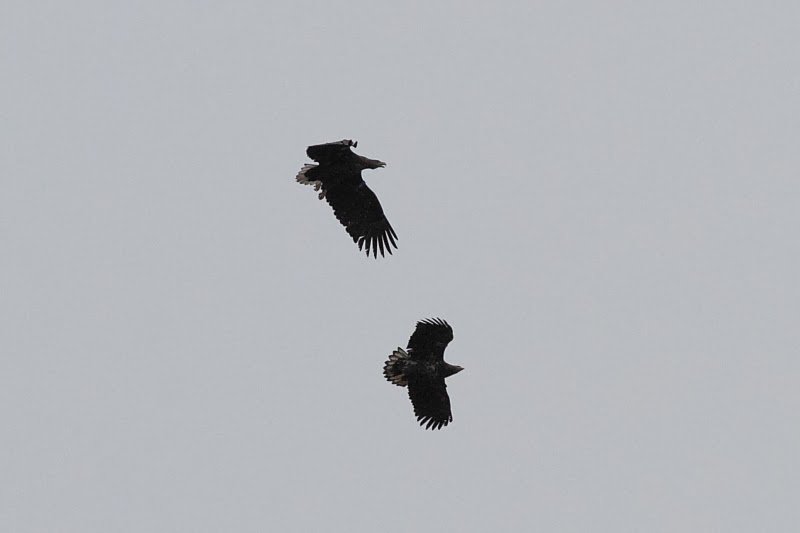
Another WTE update. I got great views the young pair of eagles last Friday. As you can see there was a little bit of aerial display happening between the two. Interestingly though I had Inverted Triangle, the female roosting with the single male F Bar on one night last week so maybe she is keeping her options open?

While driving up to Mayo on Saturday morning I had an eagle flying over the road not far from Westport. I managed to grab the camera and fire off a few record shots to try and establish what individual it was. I thought it may have been D or F Bar but no, amazingly it was a new individual C Bar! He comes from the same batch as D & F Bar which were released in 2011. This male was last seen up on Lower Lough Erne, Co. Fermanagh in September. I wonder where it's been since? Couldn't pick it today on the radio receiver, maybe it was just passing through. I wouldn't be surprised if it shows up in Connemara at some stage, seems to be the place to be for WTE at the moment!

Inverted Tri up top with D Bar below.

Opposite position this time round.

Female calling with the male.

The female is one year older than the male and you can see the difference in the tail colour between the two.

The size difference is very noticeable with the female being bigger.

Inverted Triangle the female.

Inverted Triangle the female.

Inverted Triangle the female.

Inverted Triangle the female.

D Bar the male.

D Bar the male.
 
D Bar the male showing the different aged primaries.
 
C Bar the new male.

C Bar the new male.


Sunday, 9 February 2014

Random Winter Birds


Hooded Crow chasing Raven, just shows the size difference between the two!


Lesser Redpoll, Loughrea


Norwegian ringed Black-headed Gull, Loughrea. 


Chough, Aughrusbeg


Mallard, Renvyle

Male Pintail with Mallard pair, Murlach.


Male Pintail with male Mallard at Murlach, only the second Pintail I've seen on mainland Connemara,


Whooper Swan family, Murlach.

Young Whooper Swan, Murlach.
 
Redshank, Renvyle


Saturday, 8 February 2014

Storm Damage

Here's a very small selection of what the recent storms have produced here in the last month or so.
Since November in Galway we've had five dolphin species (Common or Striped), five definite Common Dolphins, a Leatherback Turtle and a Loggerhead Turtle washed up dead along the coastline, an unusual high number. This is probably due to the extremely rough weather we've had.
There's also been extensive damage all along the coastline to roads, piers and sandy areas, a few examples below.


Common Dolphin, Aillebrack, Ballyconneely.


Different Common Dolphin, Aillebrack, Ballyconneely. Note the rope around the tail fluke...

Dogs Bay, road washed away.

Rusheenduff Lough with the former Golf course in the foreground.

Renvyle Gold Course covered in shingle.

Former 2nd hole on the gold course!
 
Road down to Murlach, Ballyconneely. Sea came across the field on  the left, over the road and inundated the lough, flooding it in the process. This is the second time this has happened in a month.


Saturday, 1 February 2014

January White-tailed Eagle update

I thought I'd give an update on how the White-tailed Eagles are doing at the moment in Connemara. Amazingly we now have FIVE White-tailed Eagles currently residing in West Galway.

The adult pair (which includes Star the male) are still visiting their usual haunts. On a rough estimate, Star who's satellite transmitter is still working uses a area of around 270 square kilometres/67,000 acres/27,000 hectares. Given the size of this area one can imagine how difficult they can be to see on any given day! They have been with us now since March 2012. Both Star and the female were released in Killarney National Park in 2009 and have a green tag on the left wing (every bird from every year has a white tag on the right wing). The female has the symbol of a semi-circle on her tag. We are hoping that they might have a serious attempt at breeding this Spring as they are probably old enough now at this stage.

Star partially hidden lower down with the female above.
Some of you may be aware that a second pair has also set up residency in another part of Connemara. The male is D Bar and the female is Inverted Triangle. The male (black tag) was released with the last batch of White-tailed Eagles in Killarney in 2011.The female (blue tag) was released in 2010. I haven't managed to get any shots of the female yet but there's a pic of the pair today on the Golden Eagle Trust Facebook site here, thanks to Cameron Clothworthy  https://www.facebook.com/photo.php?fbid=646674108723839&set=a.145791098812145.28838.144404808950774&type=1&theatre
All of the eagles, except the handful of birds who got satellite transmitters (like Star) were fitted with radio transmitters. The batteries only last 3 - 4 years. As a result this younger pair are a lot easier to track on the ground. The male in particular seems to travel further and feeds over an even bigger area than Star, approximately 330 square kilometres! They are still young birds and we're not expecting anything on the breeding front this year. Hopefully they won't get up and move to another part of the country at this stage as they seem happy enough with the area they're in.

D Bar down by the seashore still with a lot of white mottling to the underparts  though he already has a yellow bill..

Usual grief from Hooded Crow.

 
D Bar in the mountains with about 35 Ravens.


Note the black fringed tail feathers, the dark head and the white mottling to the underparts which indicates the age.


As small as the Ravens compared to him were the Magpies were tiny. Bear in mind the female would be even bigger than the male!

Well out checking on the young pair I happened to run through other birds frequencies on the radio receiver by chance and found a new bird called F Bar. I've only seen him on one occasion even though I've gotten radio signals from him several times now. He spent several months during the summer up in the Cavan/Longford area along with another young male eagle.  He's in a particularly remote area which makes seeing him a little difficult. He is using a small area within D Bar and Inverted Triangles "territory". As the pair are still relatively young they are probably more tolerant of another single young bird. I wouldn't think the same could be said of the adult pair.


Squint and you might be able to see a blob which is F-Bar under the watchful eye of a Raven.