Sunday, 20 April 2014

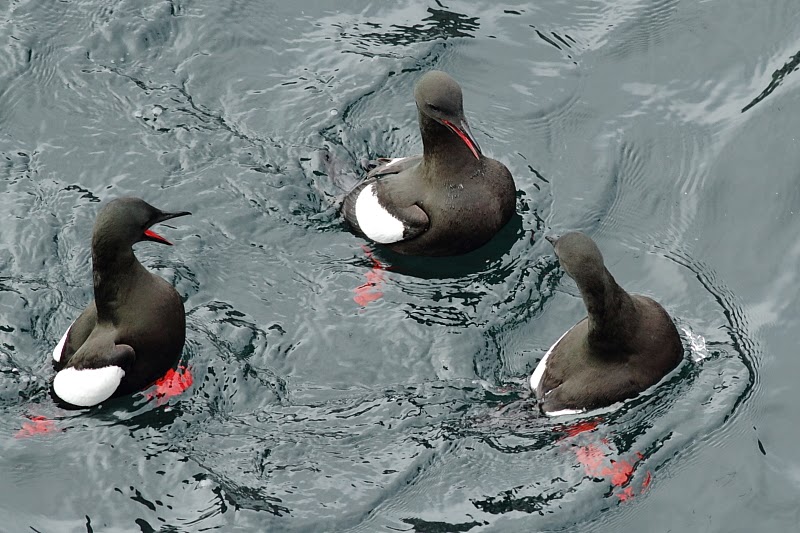
Inishbofin Black Guillemots

Another highlight from last Friday on Inishbofin were the great views of Black Guillemots. Black Guillemots gather just offshore from their nests first thing in the morning. Morning counts are the standard means of surveying the species as they generally are out of view when at the nests as these are usually under boulders at the bases of cliffs. Pairs often squabble amongst themselves and can be quite vocal giving a high pitched wheeze. I had two separate flocks up at Dún More of 20 and 23 birds and a further 15 off the back end of Knock. I'm sure there are plenty other pairs around  the island.


Saturday, 19 April 2014

Inishbofin 18th April 2014

I got the evening ferry out to Inishbofin on Thursday evening to get a full day out there the following day. The first ferry doesn't arrive out until 12 o'clock and leaves again at 5 so trying to get anything done out there is always done in a rush. I managed to get to most of the spots I had hoped to, it was around an 18km round walk, two sore feet by the end of the day! The sea cliffs are the real attraction for me at this time of year on Inishbofin. Two of the three Raven nests were successful with two and three large chicks respectively. This is a little on the low side as the average clutch size of chicks this year was around four chicks. The female Peregrine was also around but doesn't appear to have laid eggs yet which she really should have by now. The Peregrines here never seem to be very successful for some reason. It certainly can't be the lack of food so it's hard to know why? I also had probably three nesting pairs of Chough around the island, even managed to see part of one of the pairs nest wedged into a crack in a cliff.
There was a Black-throated Diver giving good views with around 20 Great northern Divers off the sandy beach at Westquarter. I  think this is the first proper island record for this species. Anthony McGeehan has seen one from the ferry in the past though. Also in the same area were two female Merlin which were seen interacting with each other. One actually called as it flew over me. These are presumably migrants, possibly Iceland bound? Males which are always first on the breeding grounds (that is if they ever leave) should be on territory for a month at this stage. Quiet on the migrant front 3 Chiffchaffs, 1 Blackcap and a few Wheatears including one female Greenland type.

Fulmar

Fulmar

House Sparrow

House Sparrow

Rock Pipit collecting nest material. Note the pink flush to the throat and the sparse underpart streaking which are features of littoralis Scandinavian Rock Pipit. However it did lack a noticeable whitish supercillium.

Rock Pipit. This shot was taken in the rain so the exposure is a bit off but again note the pink coloration to the breast, bluish tones to the head, sparse underpart streaking and white supercillium. This would probably be called littoralis by some. This bird seemed to be paired up with another much more typical looking petrosus Rock Pipit, so is this natural variation amongst the local population or what??

Skylark

Shag nesting on sea stack.

Sanderling moulting some of the wing feather tracts into summer plumage.

Typical looking local female Wheatear
Female Wheatear, most likely the leucorhoa Greenland race, note the colour tone difference between the two.

Three male Wheatears, probably migrant birds. All three fairly typical looking so probably not heading too far North.

Puffin and Razorbill skulls. The Puffin skull was a little mangled, I think the lower mandible has been twisted upside down. That's the upper mandible of the Puffin on the left which was detached.

Dead adult male Otter. Not sure what happened to this poor fella. Found in an isolated spot so certainly not a road casualty. It didn't appear to be a young animal as it was missing some front incisors and the canines were worn.

Front pad of the Otter.
 
Duach beach, some erosion here same as all sandy beaches on the West coast after the winter storms.
There used to be a lovely stone pier leading out the derelict fish curing station here, not anymore after the storms!

Prísún/The prison, an impressive blow-hole land bridge. The bigger rocks washed up by the sea probably weigh a few tonnes each.

Davillaun

Inishturk
 

Monday, 14 April 2014

From Cashel, Connemara to An Hoa, Vietnam

I was up on Cashel Hill on Sunday to check on a Raven nest to see if was in use this year. It's a fairly easy climb being only 310 metres high. No sign of the Ravens up there this year unfortunately. Some great views from the top though.

Raven eyrie, no one at home this year however.
Twelve Ben Mountain range looking North from Cashel Hill.

Maumturk Mountains looking NE from Cashel Hill.

Cashel Bay & Lehanagh North looking South from Cashel Hill.
Cloonisle/Blackhaven Bay with Errisbeg in the background, looking to the SW of Cashel Hill.

Glenturkan Lough, also called The Shamrock Lakes on account of its distinctive shape.

Old pre-Famine track running across the bog just to the south of the hill coming from the graveyard and onto Lettershinna.


Small island on a nearby bog lough. Note the Hooded Crow nest in the Birch to the right. Might make a good Merlin nest next year if the Hoodies vacate it.

 
Tobar Chonaill/Saint Connall's Holy Well. There are dozen of holy wells in Connemara. Although called "holy" most in fact pre-date the arrival of Christianity here by centuries if not millennia. Most of these "pagan" sites were taken over by Christianity to make the conversion of the Irish population that bit easier.

I came across this headstone in the back of the small graveyard at the base of the hill. Cashel native Lance Corporal "Petie" Nee was killed in action aged only 22 during the Vietnam War while serving in the 2nd Battalion, 5th Marine Regiment USMC.


This newer headstone was paid for by Vietnam veterans and was erected only last year. More details here
http://connemarajournal.ie/marines-join-nee-family-to-honour-petie/

Wood Anemone

Wood Sorrell

Dog Violets


Saturday, 5 April 2014

Nesting Ravens Part One

I've been monitoring Raven nests here in Galway mostly Connemara for at least three years. There usually isn't a whole lot happening in the Twelve Bens and Maumturk Mountains over the winter/early Spring period. I remember doing a two hour Time Tetrad Visit for the Bird Atlas up in the Twelve Bens not that long ago and the only bird I saw in the entire two hours was a single Raven! I don't think most people realize what a poor state the uplands of Connemara (and of the West of Ireland in general) are in due to gross overgrazing in recent decades thanks to ill-though out European headage payments for sheep. The damage done by this policy will take many years to be reversed. Iconic upland species such as Golden Eagles, Peregrines, Red Grouse, Golden Plover, Curlew and Ring Ouzel have all been lost here. It will probably take decades for some of these to return, that is if they ever do.

Anyway I digress, Ravens are one of the few large bird species that have managed to hang in there in the uplands. There's a high density of breeding Ravens within the Twelve Bens and the Maumturks due to two main factors. The first is the large number of sheep on the hills which results in a good source of carrion. Secondly there's a good source of suitable nesting sites i.e. cliffs/crags. The huge majority of Raven nests are located on these. No doubt some of these Raven nests were probably historically Peregrine and even Golden Eagle eyries back in the day. Of the 60 nests that I'm monitoring this year, fifty are found on cliffs/crags/quarries, six are on old buildings and only four are in trees. Raven pairs will move nests most years from distances of just metres and up to 1.29km away. Generally territorial pairs are spaced three kilometres from each other although this can vary as I had two exceptional active nests one season that were only 800 metres apart, this hasn't been repeated since however. Some have commented that there is an "unnaturally high concentrations" of Ravens in some areas but then in turn cannot justify statements like these with hard facts as to what a "natural" concentration of Raven normally would be. Most "dewy-eyed conservationists" fully accept that Ravens are indeed adept predators but describing that as "menaces" and "rogues" is reminiscence of the Victorian thinking of predators. The notion of the lion and the lamb lying together is about as unnatural a mind-set as one can get and it's time these same people acknowledged this. I accept that predator control can be necessary in some limited situations if there is an essential reason for it and if is it carried out in the correct lawful way and at the right time of year.
One of the nests that I checked this year had three eggs in it but on a subsequent visit the nest was found to be empty. The same nest cannot be access without ropes from above so human interference was most unlikely (Ravens are given full protection under the Wildlife Act by the way). While checking another nest this year I found two of our colour rings directly below the nest in which we had ringed a clutch last year. These chicks must have fallen out of the nest and were then probably taken by a mammalian predator. The nest was located on a tiny ledge with just enough room for the nest so there would have been little room for near-grown chicks to explore and exercise before capable of full flight. So Ravens are far from immune from predation themselves.

As part of the monitoring I try to record clutch sizes of the few accessible nests. As a rule most Raven nests are located directly beneath a rocky overhang for shelter and are usually hidden from above. I use a telescopic pole with a camera clamped onto its end to inspect the nest. An example of the video is shown below. This is all done under license from NPWS under Section 22 (9)(f) of the Wildlife Act, 1976 (as amended).  I've managed to record clutches of two three egg, two four egg, three five egg, four six egg and a single seven egg clutch this season.
Most Raven eggs have now hatched and we should hopefully be ringing a few of these nests within the next fortnight or so.

Two colour-rings found below a Raven nest in which we ringed chicks last year. Note the chew marks on the E ring!

Note the different colour shades and patterning within the same clutch, taken under NPWS license.
 
Rare seven egg clutch, taken under NPWS license.